Tag: Shark Tank India

  • Kids & Lifestyle Brand Rosada Secures Rs 1.25 Crore Deal on Shark Tank India

    Kids & Lifestyle Brand Rosada Secures Rs 1.25 Crore Deal on Shark Tank India

    Kids-focused lifestyle brand Rosada featured on Shark Tank India, where founders Shalu Agarwal and Bhupesh Agarwal shared their journey of building a design-led brand catering to young parents and children.

    During the pitch, the founders explained that Rosada operates in the kids’ essentials and lifestyle space, offering products across backpacks, tote bags, bedding sets, travel kits, pouches, décor, and baby bedding. One of the brand’s most popular products is the Lazy Zoo diaper backpack, designed to be lightweight and water-resistant. Manufacturing is handled in-house, enabling tighter control over quality, pricing, and margins.

    Entering the Tank, the founders sought ₹1.25 crore for 4% equity, valuing the company at ₹31.25 crore. They shared that Rosada was founded in 2013, with its website launching in 2020. Bhupesh joined the business full-time in January 2022, helping scale operations and accelerate growth.

    Rosada caters to children aged 0–12 years and generates nearly 95% of its sales through its own website, with the remainder coming from other channels. The brand has built strong digital traction, amassing 135K Instagram followers, supported by a monthly marketing spend of around ₹16 lakh, delivering a ROAS of over 5x.

    Financially, the company has shown consistent growth. Sales increased from ₹48 lakh in FY21–22 to ₹1.23 crore in FY22–23, followed by ₹3.52 crore in FY23–24 and ₹6.48 crore in FY24–25. Year-to-date sales stand at ₹6.7 crore, with projected revenues of ₹12.5–13 crore in FY25–26. The brand reports an average order value of ₹1,990 and a healthy 31% six-month repeat rate.

    https://app.ceotrail.com/apparel-brand-warrior-world-secures-rs-75-lakh-deal-on-shark-tank-india/

    Rosada has also begun expanding offline, launching in Hamleys stores in June 2025, where each outlet is generating ₹1.5–1.75 lakh in monthly sales. Currently, 60% of revenue comes from bags, followed by pouches and travel sets (20%), beddings and accessories (10%), and décor and baby bedding (10%).

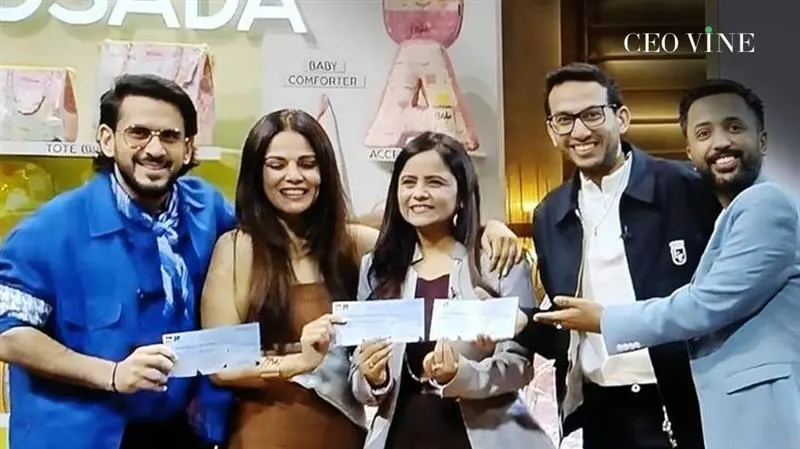
    After negotiations, the founders closed a deal with Aman Gupta, Namita Thapar, and Ritesh Agarwal, who jointly invested ₹1.25 crore for 5% equity, along with a 2% royalty until ₹1.25 crore is recouped, valuing Rosada at ₹25 crore.
  • Art-Tech Startup Artociti Secures Rs 1 Crore Deal on Shark Tank India

    Art-Tech Startup Artociti Secures Rs 1 Crore Deal on Shark Tank India

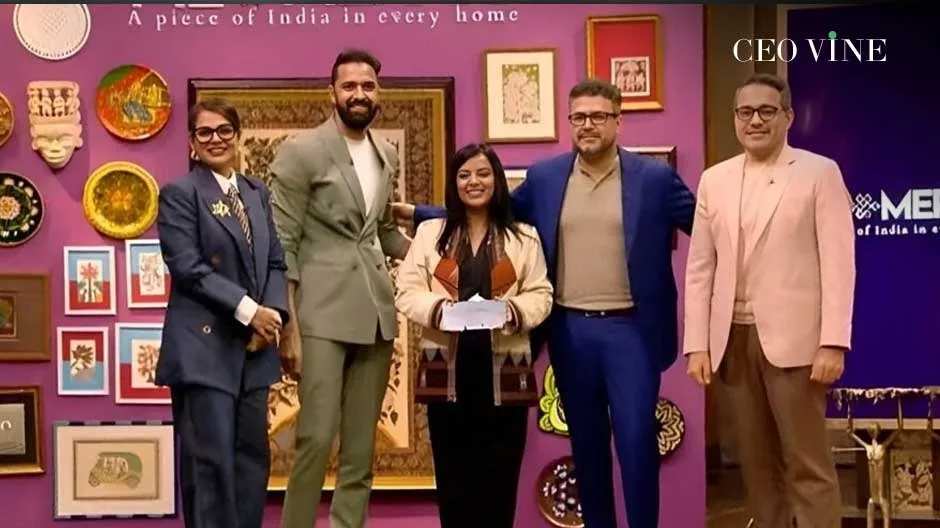
    Home decor and art-tech startup Artociti featured on Shark Tank India, where founders Indrajeet Kumar and Swatiki Prakash showcased how they are scaling traditional relief mural art into a mass-market brand. The duo is on a mission to make premium, hand-sculpted wall art accessible to homes and businesses across India.

    During the pitch, the founders explained that Artociti bridges the gap between artisanal craftsmanship and industrial scalability. The process begins with intricate hand-sculpting using Ganga clay, which is then converted into fiberglass moulds for mass production. This “art-tech” approach allows them to offer the premium look of traditional murals with the durability and speed of modern manufacturing.

    Entering the Tank, the founders ask was Rs 1 crore for 3% equity, valuing the company at ₹33.33 crore.

    The team highlighted that Artociti is a bootstrapped success story, operating with an in-house manufacturing setup and a team of 78. A significant driver of their success is their direct-to-consumer (D2C) strength, with 90% of sales coming directly from their own website. The brand operates a highly optimized logistics cost of Rs 700–Rs 800 per order.

    The brand’s growth trajectory has been aggressive. Sales skyrocketed from just Rs 12,500 in FY21 to Rs 3.44 crore in FY25, with the current year-to-date (YTD) revenue already hitting Rs 3 crore. The founders are projecting sales of Rs 5.5– Rs 6 crore for FY26, with a long-term target of Rs12 crore by FY27. Artociti currently operates at a 9% EBITDA (YTD).

    https://app.ceotrail.com/culture-tech-platform-memeraki-secures-rs-1-crore-deal-on-shark-tank-india/

    Artociti’s product catalogue is diverse, featuring relief murals, canvas paintings, wall accents, and sculptures. However, relief murals remain the powerhouse, contributing 80% of total sales. Their pricing and product mix have resulted in a strong Average Order Value (AOV) of ₹8,500.

    After a series of negotiations regarding their valuation and manufacturing challenges, the founders closed a deal with Vineeta Singh and Namita Thapar. The Sharks invested Rs1 crore for 7.5% equity, along with a 2% royalty until Rs1.5 crore is recouped, valuing the company at Rs13.33 crore.

    With a total of 300+ unique moulds and a growing presence in Tier 2 and Tier 3 cities (which account for 40% of their customer base), Artociti plans to use the fresh capital to expand its manufacturing capacity.

  • Culture-Tech Platform MeMeraki Secures Rs 1 Crore Deal on Shark Tank India

    Culture-Tech Platform MeMeraki Secures Rs 1 Crore Deal on Shark Tank India

    India’s leading culture-tech platform MeMeraki featured on Shark Tank India, where founder Yosha Gupta shared how she is building a technology-led market access for traditional Indian arts and crafts designed specifically to empower master artisans as contemporary digital creators.

    During the pitch, the founder explained that MeMeraki focuses on democratizing the heritage arts economy by connecting rural master artisans with global audiences. Unlike traditional handicraft marketplaces, the platform operates a “dual model” combining a premium e-commerce marketplace for authentic products with a dynamic ed-tech platform offering live and recorded masterclasses. These venues for cultural learning allow anyone to explore an authentic connection with their heritage through artists who have inherited generational knowledge.

    Entering the Tank, the founder sought ₹50 lakh for 1.67% equity, valuing the company at ₹30 crore.

    The founder shared that the business is built on a disciplined and impact-led model. Since its inception in 2019, MeMeraki has scaled through content-led discovery and deep artisan partnerships. A major driver of their scalability is the diversified revenue stream, with a mix of 60% consumer (B2C) and 40% enterprise (B2B) services, the latter of which delivers large-scale art installations and murals for organizations like GMR Hyderabad Airport and the Ministry of Culture.

    Operationally, MeMeraki currently connects over 500 master artisans across 300+ traditional art forms and has reached customers in more than 40 countries. The founder highlighted strong momentum, demonstrating consistent year-on-year growth and achieving profitability in the current financial year.

    https://app.ceotrail.com/the-binge-town-secures-rs-2-crore-deal-on-shark-tank-india/

    The platform is managed via a tech-enabled infrastructure that supports 10,000+ handcrafted products and immersive learning experiences. Use cases range from high-value corporate advisory projects and public installations to individual patrons purchasing original artworks like ₹1,05,000 Kalamkari paintings or attending digital workshops.

    After negotiations, the founder closed a deal with Varun Alagh, Namita Thapar, Kunal Bahl, and Viraj Bahl, who collectively invested ₹1 crore for 4% equity. The deal values MeMeraki at ₹25 crore.

  • Apparel Brand Warrior World Secures Rs 75 Lakh Deal on Shark Tank India

    Apparel Brand Warrior World Secures Rs 75 Lakh Deal on Shark Tank India

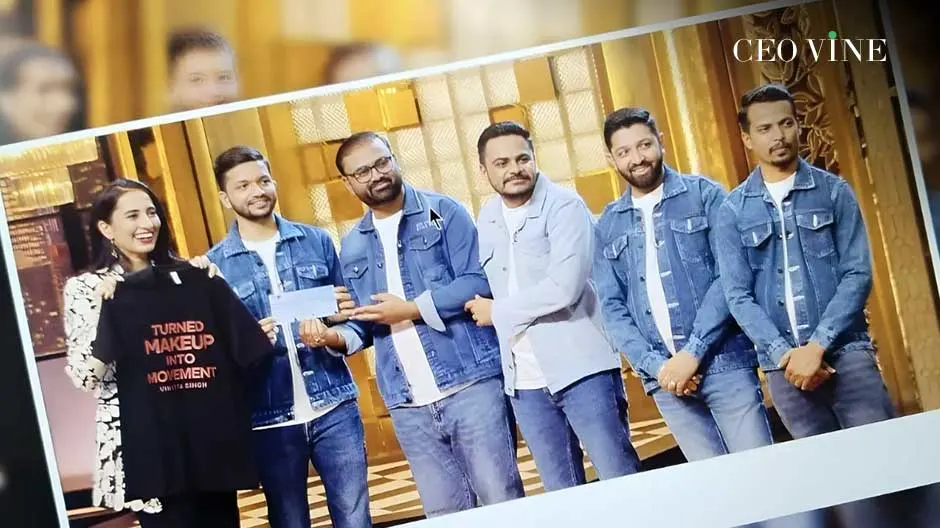
    Army-inspired apparel brand Warrior World featured on Shark Tank India, where founders Keyur, Uday, Dharmin, Kapil, and Jigar shared how they are building a mass-market clothing label aimed at taking military-inspired fashion to every corner of the country.

    During the pitch, the founders explained that Warrior World is focused on democratising patriotic fashion through durable, high-quality streetwear. Unlike fast-fashion players, the brand operates with a large catalogue, with 82% of sales coming from army-inspired designs. Each product is engineered for longevity, featuring high-density prints tested to last up to 50 washes. Printing is handled in-house through a DTF setup, while fabric sourcing is outsourced to keep operations lean.

    Entering the Tank, the founders sought ₹75 lakh for 1% equity, valuing the company at ₹75 crore.

    The team shared that Warrior World is built on a highly efficient, bootstrapped model. After running women’s ethnic wear ventures like Bahuji between 2015 and 2023, the founders pivoted to launch Warrior World. A key driver of profitability has been sharp operational optimisation—RTO rates dropped from 42–43% in the early days to just 2.5%, while shipping costs were brought down dramatically from ₹215 per order to ₹50.

    Growth has been rapid. The founders stated that sales jumped from ₹92,000 in FY23–24 to ₹6.4 crore in FY24–25, with projections of ₹30 crore in FY25–26. The brand currently operates at 15% EBITDA (YTD) and reports a 24% repeat rate. Its pricing strategy keeps products accessible, with single t-shirts at ₹399, packs of three at ₹999, and packs of five at ₹1,499.

    Warrior World runs on an in-house tech-enabled order management system, with 98% of sales coming directly from its website. Its made-to-order manufacturing model ensures zero finished-goods inventory, allowing for efficient dispatch through a ready pick-list system.

    https://app.ceotrail.com/the-binge-town-secures-rs-2-crore-deal-on-shark-tank-india/

    After negotiations, the founders closed a deal with Vineeta Singh, who invested ₹75 lakh for 1% equity, along with a 1.5% royalty until ₹1.25 crore is recouped, valuing the company at ₹75 crore.

    Prior to Shark Tank, Warrior World was entirely bootstrapped and had already achieved lifetime sales of ₹20 crore. With fresh capital and strategic backing, the founders plan to scale further by improving their customer lifetime value of ₹2,100 and average order value of ₹940, as they work toward standardising military-style streetwear across India.

  • The Binge Town Secures Rs 2 Crore Deal on Shark Tank India

    The Binge Town Secures Rs 2 Crore Deal on Shark Tank India

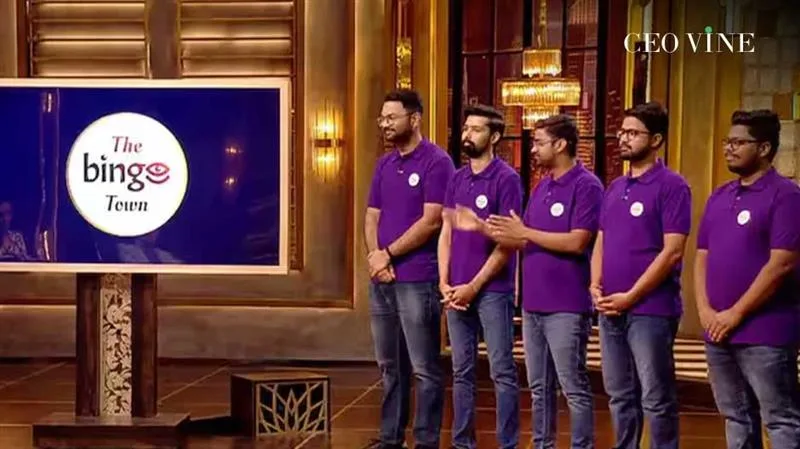
    Private celebration venue platform The Binge Town stepped into the Shark Tank India with founders Soumay , Sanketh , Yash , Chetan , and Bishnu , pitching a high-margin, “hospitality-first” alternative to traditional banquet halls, designed specifically for intimate group celebrations.

    At its core, The Binge Town is all about democratizing luxury celebrations. By converting urban spaces into private mini-theatres, the startup allows users to book exclusive venues for birthdays, anniversaries, and romantic dates. Unlike public cinemas or restaurants, every booking comes with “celebration-locked” features including customizable LED décor, Sony 5.1 surround sound, gourmet F&B menus, and professional photography “reel” captures.

    In the Tank, the founders asked for ₹2 crore for 2% equity, valuing the company at ₹100 crore.

    The founders explained that the business is built on a highly profitable bootstrapped model. Having started with just ₹60 lakhs in 2022, operational income ₹3 crores from internal profits back into the business. Their unit economics are fueled by high-margin add-ons; while the entry price for a venue is affordable, most customers opt for premium decoration and food packages, pushing the average ticket size significantly higher.

    The Binge Town currently operates 64 private theatres across  in 7 major cities and has already crossed the milestone of 100,000 bookings. Their revenue growth has been aggressive, jumping from ₹5.7 crores in FY24 to a projected ₹27+ crores in FY26 with a steady 11% Profit Before Tax (PBT).

    https://app.ceotrail.com/meat-marinade-brand-kilrr-bags-rs-1-cr-investment-on-shark-tank-india/

    The product is managed via a tech-enabled booking platform where users can customize every detail of their event in real-time. Key use cases range from romantic proposals and 2-seater “couple dates” to 20-seater family birthday parties.

    They closed a deal with Varun Alagh for ₹1 crore for 2.5% equity plus ₹1 crore debt at 15% interest, valuing the company at ₹40 crore.

    Before Shark Tank, The Binge Town was entirely bootstrapped and profitable since day one. The fresh capital and Varun Alagh’s expertise will be used to scale to 200+ venues by the end of 2026, focusing heavily on FOFO (Franchise Owned, Franchise Operated) expansion into Tier II and Tier III markets.

  • Panda’s Box Secures Investment on Shark Tank India at Rs 10 Cr Valuation

    Panda’s Box Secures Investment on Shark Tank India at Rs 10 Cr Valuation

    Kids-focused cultural learning brand Panda’s Box featured on Shark Tank India, where founders Rajat Mendiratta and Sukriti Mendiratta shared how they are building a content-led brand that blends Indian culture, storytelling, and interactive learning for young children.

    During the pitch, the founders shared that Panda’s Box was founded in April 2022 as a cultural education company with a strong focus on children in the 0–2 years age group. The brand operates across categories such as plush toys, puzzles, sound boxes, sound books, and décor, with a clear emphasis on sensory and interactive learning rather than passive consumption.

    The founders highlighted that Panda’s Box currently offers 40+ SKUs, with its key differentiator being interactive plush toys paired with audio-led content. Each product includes up to 30 minutes of storytelling and mantras, supported by a dedicated mantras library hosted on the brand’s website. The content spans stories, mantras, and cultural audio, reinforcing Panda’s Box’s education-first positioning.

    At launch, the brand introduced Baby Krishna, Baby Ganesha, and Baby Hanuman plushies handmade, India-made divine toys priced at ₹799 (small), ₹999 (medium), and ₹1,599 (large). The founders also shared that the company has expanded into publishing with the recent launch of “My First Book of Mantras.”

    On the business front, the founders presented a strong growth trajectory. Revenue stood at ₹53 lakh in FY 22–23, grew sharply to ₹2.93 crore in FY 23–24, and reached ₹8.77 crore in FY 24–25, with year-to-date sales of ₹8 crore. Looking ahead, Panda’s Box is projecting ₹14 crore in revenue for FY 25–26.

    Profitability trends were also discussed during the pitch. EBITDA improved from ₹9 lakh in FY 22–23 to ₹13 lakh in FY 23–24, and further to ₹55 lakh in FY 24–25. While the brand currently reports YTD EBITDA of -₹49 lakh, the founders shared that they expect to reach EBITDA breakeven in FY 25-26.

    In terms of distribution, Panda’s Box operates a diversified channel mix. About 33% of sales come from its own website, 37% from quick commerce platforms, 25% from Amazon, and the remaining 5% from other channels. The founders noted a 15% repeat rate YTD on the brand’s website (12% in FY 24–25), while Amazon listings maintain strong 4.5–4.6 star ratings. Channel-wise, the brand recorded 100% growth on its website in FY 24–25, with 40% YTD growth, and 30% YTD growth on Amazon.

    Panda’s Box is currently bootstrapped. On the show, the founders shared that they are seeking ₹80 lakh for 2% equity, which puts the company’s valuation at ₹40 crore.

    https://app.ceotrail.com/upi-voucher-platform-cotopay-secured-rs-75-lakh-deal-on-shark-tank-india/

    During the pitch, a deal was eventually closed with Aman Gupta and Namita Thapar, who invested ₹1.2 crore for 12% equity, along with a 2% royalty until the ₹1.2 crore amount is recovered. This deal values the company at ₹10 crore.

    The founders also highlighted a key team milestone, sharing that October 2024 marked Rajat joining the business full-time, signaling deeper founder involvement as Panda’s Box enters its next phase of growth.

  • UPI Voucher Platform CotoPay Secured Rs 75 Lakh Deal on Shark Tank India 

    UPI Voucher Platform CotoPay Secured Rs 75 Lakh Deal on Shark Tank India 

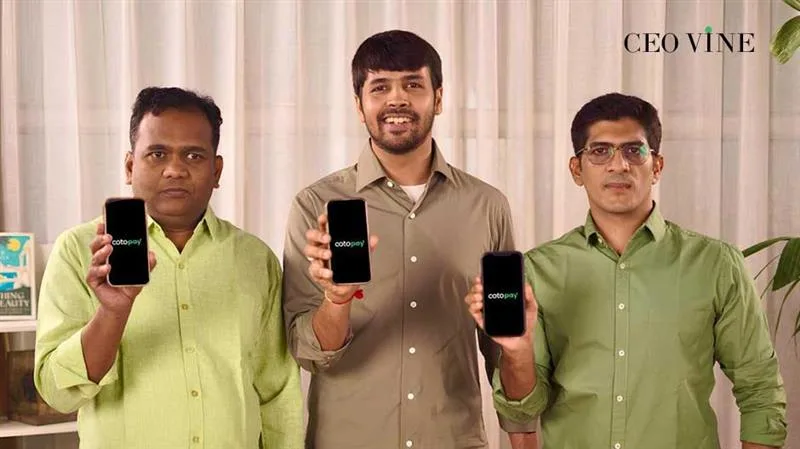
    UPI-based voucher platform CotoPay stepped into the Shark Tank India with founders Aviral Gupta (CEO)Vidit Sidana (CBO), and Syed Uzair Ahmed (CTO), pitching a smarter way for businesses to control how digital money gets spent using India’s existing UPI rails.

    At its core, CotoPay is all about bringing control and transparency to vouchers. Instead of handing out prepaid balances with little visibility, companies can issue UPI-linked vouchers that come with clear rules where the money can be spent, how long it’s valid, and full traceability of every transaction.

    The founders explained that unlike traditional voucher systems, the money issued through CotoPay doesn’t immediately leave the company’s account. Funds stay within the company ecosystem until the voucher is actually redeemed. Employees or users simply scan a QR code and pay via UPI, while businesses retain full oversight on categories, usage, and spend behavior.

    CotoPay kicked off closed user group testing in December 2025 and currently has five pilot users. The startup has already tied up with five banking partners and is initially focusing on SMEs and fleet operators. Its revenue model is straightforward, earning a 0.5% to 0.7% commission on the monthly transaction value processed through the platform.

    https://app.ceotrail.com/ai-music-platform-soundverse-ai-bags-rs-1-35-cr-deal-on-shark-tank-india/

    The product is available via web, iOS, and Android, with key use cases ranging from corporate expense management to loyalty-driven spending programs.

    In the Tank, the founders asked for ₹50 lakh for 1% equity, valuing the company at a Rs 50 crore valuation. After discussions, Anupam Mittal and Kunal Bahl came together to seal the deal Rs 75 lakh for 2% equity, plus 1% advisory equity, valuing CotoPay at ₹37.5 crore.

    Before Shark Tank, CotoPay had already raised Rs 2.94 crore in 2024, with investors collectively holding 17.8% of the company. Among the founders, Aviral Gupta owns 45%, Vidit Sidana holds 35%, and Syed Uzair Ahmed has 20%.

  • AI Music Platform Soundverse AI Bags Rs 1.35 Cr Deal on Shark Tank India

    AI Music Platform Soundverse AI Bags Rs 1.35 Cr Deal on Shark Tank India

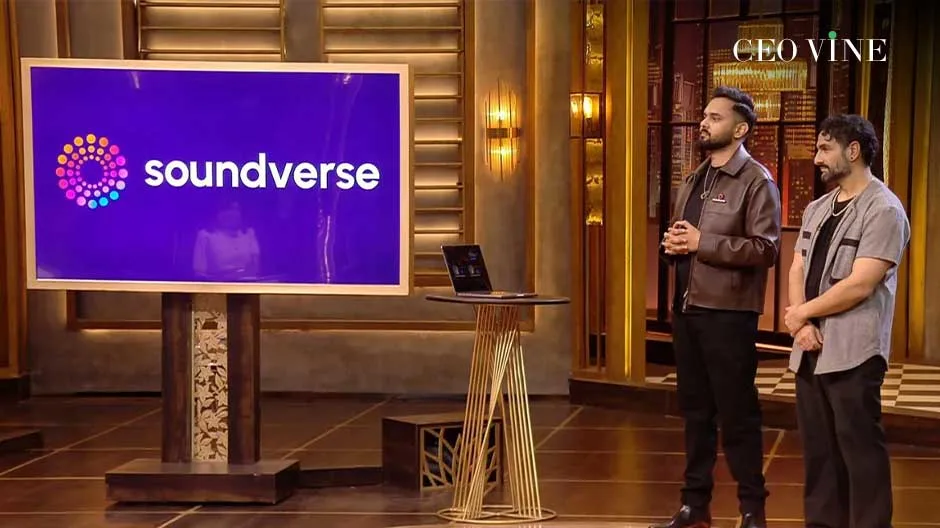
    AI-powered music creation platform Soundverse AI took the spotlight on Shark Tank India, where founders Sourabh Pateriya (CEO) and Riley Williams (CTO) shared how they are building a creator-first and ethical alternative in the rapidly evolving AI music ecosystem.

    During the pitch, the founders shared that Soundverse AI was launched in January 2024 as an AI assistant for music and content creation, designed to give creators deeper control over how songs are generated, edited, and refined.

    They highlighted a key industry concern: many AI music tools are trained on copyrighted tracks without authorisation and offer limited creative flexibility. Soundverse aims to solve this by training its foundation model exclusively on licensed data from artists, labels, and publishers, ensuring legal compliance while protecting creator rights.

    Entering the Tank, the founders sought ₹1.35 crore for 1.5% equity, valuing the company at ₹90 crore.

    The founders demonstrated Soundverse’s growing suite of AI-driven tools, which includes full song generation, editing and modification of existing tracks, and a dedicated Soundverse Agent to support end-to-end creative workflows. One of the platform’s standout features is “Sharks’ Suggestions,” which allows users to guide the AI using mood and style descriptors such as Hans ZimmerExcited, or Charm. They also pointed to industry credibility, including a professional connection to Ash Pournouri, a judge from Swedish Idol.

    Sharing traction metrics on the show, the founders revealed that Soundverse AI has crossed 25 lakh users (2.5 million) since inception, with around 1.7 lakh monthly active users as of May 2025. The platform is currently accessible via its website, the Apple App Store, and the Google Play Store.

    Revenue growth, as shared during the pitch, accelerated significantly toward the end of 2025. Monthly revenues increased from ₹11 lakh in September 2025 to ₹13.5 lakh in October, before jumping sharply to ₹86 lakh in November.

    Earlier in the year, revenues had grown steadily from ₹5.5 lakh in June 2025 to ₹9.5 lakh by August. Soundverse follows a subscription-led model, offering three monthly plans Creator (₹150)Pro (₹350), and Max (₹999) and currently operates at a monthly burn of around ₹15 lakh.

    https://app.ceotrail.com/wholeleaf-secures-rs-1-5-crore-deal-on-shark-tank-india/

    Looking ahead, the founders shared ambitious targets, aiming to reach ₹8–10 crore in ARR within the next 6–12 months.

    After discussions, Namita Thapar closed the deal by investing ₹1.35 crore for 5% equity, bringing Soundverse AI’s valuation down to ₹27 crore.

    Prior to its Shark Tank appearance, Soundverse AI was entirely bootstrapped, making Namita Thapar’s investment its first external funding.

  • Meat Marinade Brand Kilrr Bags Rs 1 Cr Investment on Shark Tank India

    Meat Marinade Brand Kilrr Bags Rs 1 Cr Investment on Shark Tank India

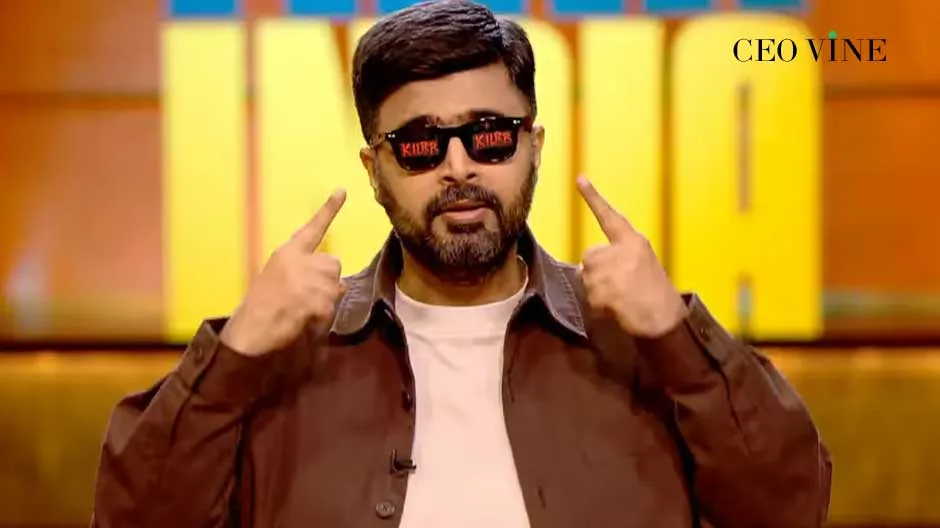
    Clean-label meat marinade brand Kilrr made a strong impression on Shark Tank India, where founder Hitesh Bhagia, an engineer and IIM Kozhikode alumnus shared his vision of simplifying meat cooking through preservative-free, ready-to-use spice mixes.

    During the pitch, Bhagia explained that Kilrr was launched in December 2023 to address a clear gap in the market: convenient, flavourful marinades made specifically for meat dishes, without preservatives or artificial additives.

    Positioned as an “unapologetically non-vegetarian” brand, Kilrr caters to fitness-focused consumers, modern home cooks, and convenience seekers. Its tagline, “Slay the mess, savour the taste,” reflects the brand’s promise of ease without compromising on taste.

    Entering the Tank, the founder sought ₹1 crore for 1% equity, valuing the company at ₹100 crore.

    Bhagia shared that Kilrr’s current portfolio includes 11 powdered marinade variants and three gravy mixes, each priced at ₹70, with an average order value of ₹660. All products use 100% vegetarian ingredients, with dehydrated vegetables blended directly into the masalas.

    The brand maintains a strict clean-label stance, with no preservatives, artificial flavours, additives, or added sugar, resulting in a six-month shelf life, lower than industry norms but aligned with its natural positioning.

    On the operations front, Kilrr set up its manufacturing unit in March 2024 and began scaling sales soon after. Financials shared on the show revealed ₹2.6 crore in net sales in FY24–25, with momentum picking up sharply ₹2.5 crore each in Q1 and Q2 of FY25–26. For the current fiscal year, the startup is projecting ₹13 crore in net sales, while operating at a projected -25% EBITDA as it continues to invest aggressively in growth.

    https://app.ceotrail.com/wholeleaf-secures-rs-1-5-crore-deal-on-shark-tank-india/

    The founder also outlined the company’s unit economics. Kilrr operates with 65% gross margins, while COGS account for 35%, logistics and packaging for 12%, and marketing spends exceed 50% of revenue. Monthly fixed costs stand at around ₹22 lakh. The brand has already fulfilled over 2,000 pilot orders and reports a 35% cumulative retention rate.

    Sales are currently driven largely through direct-to-consumer channels, with 55% of revenue coming from Kilrr’s own website and 35% via quick commerce platforms.

    After negotiations, Anupam Mittal closed the deal by investing ₹1 crore for 1.06% equity, bringing Kilrr’s valuation to approximately ₹94.3 crore, subject to customer-love and legal diligence.

  • Wholeleaf Secures Rs 1.5 Crore Deal on Shark Tank India

    Wholeleaf Secures Rs 1.5 Crore Deal on Shark Tank India

    Cannabis wellness brand Wholeleaf made a significant appearance on Shark Tank India Season 5, where founder Shivraj Sharma shared the journey of building a government-licensed wellness brand utilizing Cannabidiol (CBD) as a hero ingredient.

    Inspired by the need for better relief for chronic conditions, the brand showcased its “hero products,” including Orthodexil for arthritis and inflammation and Migroheal for migraines and headaches.

    Entering the Tank, the founder sought ₹50 lakh for 2.1% equity, valuing the business at ₹23.8 crore. During the pitch, Shivraj revealed how the brand has built a high level of medical defensibility, procuring cannabis leaves from state government-licensed sources and holding all necessary manufacturing and free sales licenses.

    To further strengthen its scientific backing, Wholeleaf has engaged in 13 total clinical trials, with two already completed and one near completion. These trials, involving 50–75 participants each, have shown impressive results, with 76%+ of patients reporting significant pain relief. This clinical-first approach helped the brand stand out as a serious contender in the medicinal cannabis space.

    Sharing operational insights, the founder explained that Wholeleaf follows a robust multi-channel distribution strategy with a strong offline presence across 600 stores.

    The brand’s channel split currently stands at 60% online (where 85% of sales come from their own website and 15% from Amazon) and 40% offline. A major driver of their offline success is Apollo Pharmacy, which contributes 90% of their offline sales and operates on a 30-day credit period.

    On the financial front, Wholeleaf demonstrated an explosive growth trajectory. The brand’s annual run rate (ARR) skyrocketed from ₹50 lakh in April 2024 to ₹9 crore by October 2025. While the business currently reports a -17% EBITDA margin, the unit economics remain strong with a 75% gross margin and COGS at 25%. The current burn is primarily attributed to logistics and commissions (13%), aggressive marketing spends (49%), and overheads (30%).

    https://app.ceotrail.com/invogue-secures-rs-2-crore-deal-on-shark-tank-india/

    According to the founder, the brand is already seeing early signs of customer loyalty with an 18% repeat customer rate. This retention, combined with their sharp revenue jump, signaled high market potential to the Sharks.

    The brand successfully closed a deal on the show, securing ₹1.5 crore for 7.5% equity, valuing Wholeleaf at ₹20 crore. The investment was a joint deal backed by Aman GuptaKanika Tekriwal, and Namita Thapar, who were impressed by the brand’s clinical validation and scale.