
Category: EdTech

  • SkyySkill Academy: A Homegrown Skilling Startup Preparing India’s Future Workforce

    SkyySkill Academy: A Homegrown Skilling Startup Preparing India’s Future Workforce

    As industries shift toward electric mobility, renewable energy, automation, and connected technologies, the gap between classroom learning and industry expectations continues to grow. Companies want talent that can work on real systems. Colleges want partners who can bring practical learning into their curriculum. Students want skills that convert into jobs.

    SkyySkill Academy, founded by Himansu Sekhar Panda, is building its place in this landscape. Headquartered in Hyderabad, the company focuses on training that happens through real labs, equipment, and hands-on engineering work rather than theory-heavy online modules.

    Where the Journey Began

    Himansu grew up in a small town in Odisha. He often saw students complete engineering without getting real exposure to equipment, tools, or industry systems. The disconnect stayed with him through his own education and early career.

    “The problem was never talent,” he says. “It was access. Students needed systems to work on, not just lectures to listen to.”

    His early years working with colleges, companies, and students made the issue more visible. The idea was not to launch a training company, but to create an environment where learners could assemble, test, build, and understand real systems.

    What started in 2018 as Skyy Rider Institutions set up in a small rented room eventually shaped itself into SkyySkill Academy. The company was formally incorporated under Telangana ROC in 2023.

    A Model Built Around Real Systems

    The company’s core belief is that engineering must be experienced, not just studied. Learners work on EV powertrains, battery modules, solar setups, embedded controllers, CAD/CAE tools, and IoT applications.

    The Academy runs alongside SkyySkill Lab, its engineering and infrastructure arm that designs and manufactures labs and Centres of Excellence for institutions. This combined structure allows the team to introduce the Learn–Earn Program, where students take part in assembling and testing systems that later get deployed in colleges across India.
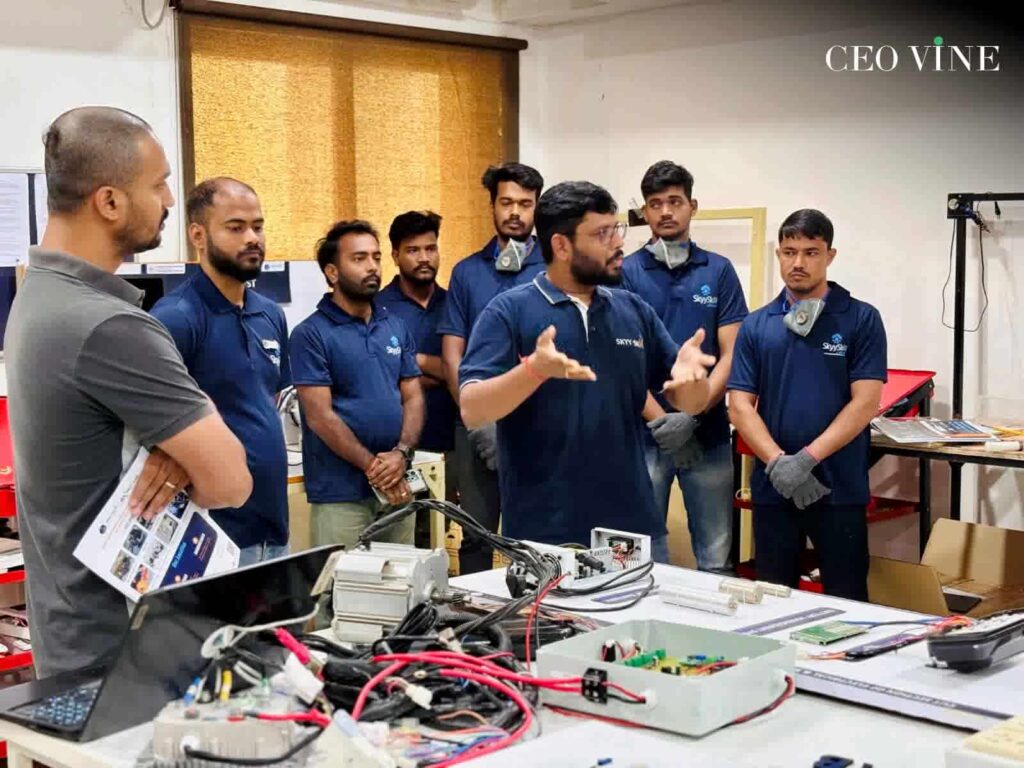
    Himanshu at his manufacturing unit explaining the technology to a client from Bosch
    Himanshu at his manufacturing unit explaining the technology to a client from Bosch

    “Our goal was not to replace colleges,” Himansu says. “It was to strengthen them. Students should not have to wait for a job to get industry exposure.”

    Building Credibility Through Demonstration

    In the early years, gaining trust was a major challenge. Institutions were hesitant to partner with a young company building advanced labs without a long track record.

    The turning point came when colleges began visiting the facilities. They watched students working on real EV drivetrains, digital-twin dashboards, battery management systems, robotics rigs, and embedded labs. Seeing the setup in action made the model easier to understand and helped SkyySkill secure its first large collaborations.

    From there, word of mouth and demonstrations drove growth. Today, the company has set up more than 60 Centres of Excellence, trained over one lakh learners, and worked with 200+ institutions across India. Its team has grown to more than 80 members.

    Institution Partnerships and Expanding Infrastructure

    SkyySkill Academy collaborates with IIT Guwahati, IIT Kanpur, MG Motor India, ASDC, ESSCI, and other industry bodies to keep its curriculum aligned with changing technologies. Inputs from EV manufacturers, renewable energy companies, embedded engineers, and academic partners are added into the training content every few months.
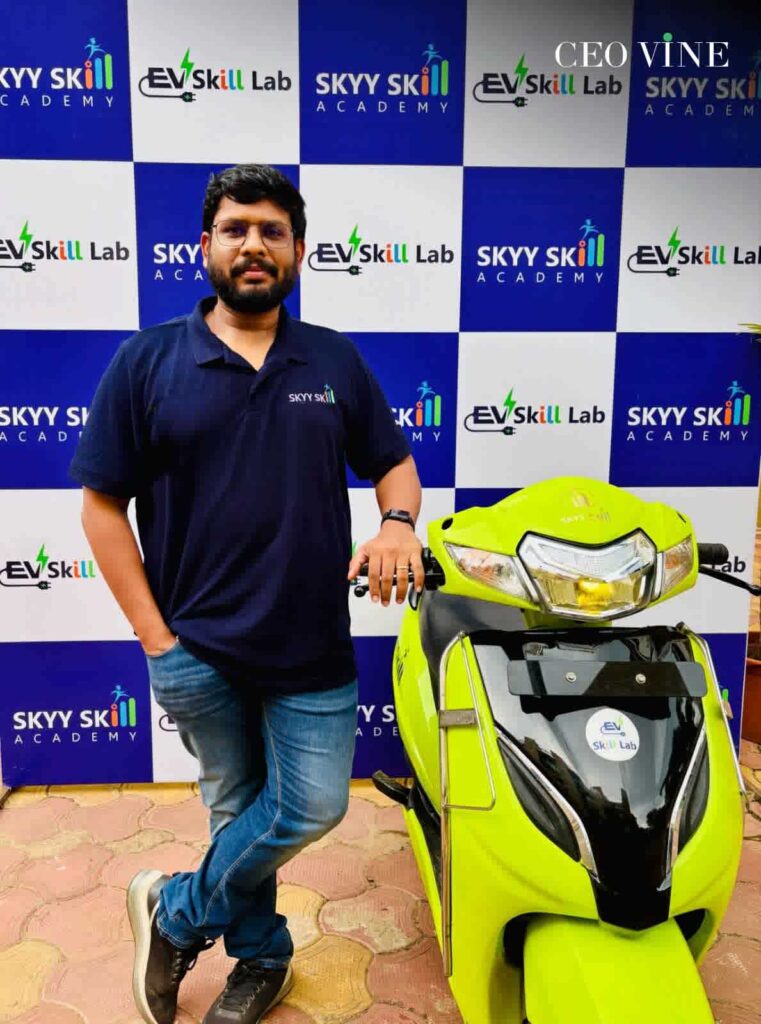
    Himanshu presenting a retrofitted EV 2-wheeler manufactured by Skyy Skill.
    Himanshu presenting a retrofitted EV 2-wheeler manufactured by Skyy Skill

    To support scale, the company introduced digital twins, AI-driven learning tools, and adaptive assessments within its LMS. These tools run parallel to hands-on sessions, allowing students to learn theory and practice together.

    A Structure With Two Divisions

    SkyySkill functions through its two verticals: SkyySkill Lab, which builds technology, labs, and CoEs, and SkyySkill Academy, which delivers training in EVs, Solar, IoT, Embedded Systems, Robotics, and other technologies.

    Revenue comes from lab deployments, institutional engagements, training programs, CSR projects, hiring partnerships, and consulting.

    A Founder Guided by Purpose

    Himansu often refers to the philosophy he shared in one of his talks, Passion, Perception, Persistence, Patience, Pursuit, and Purpose. These principles shape how the company operates and how the team approaches skilling.

    “The future workforce needs theoretical clarity and practical confidence,” he says. “Our job is to build the bridge that connects the two.”

    What Comes Next

    SkyySkill Academy is now working on advanced labs for hydrogen mobility, robotics, drones, smart grids, and AI-driven manufacturing. The team is also building hybrid learning systems that combine physical labs with AI tools and simulations.

    As India moves toward greener mobility and more technology-driven industries, SkyySkill aims to contribute to the talent pipeline by giving students access to real systems and real engineering, not just content on screens.

    SkyySkill’s story is not about competing with conventional education; it is about complementing it and giving students the confidence to handle emerging technologies. The company’s growth reflects a broader shift in Indian skilling toward practical, industry-connected training that prepares learners for what the market actually needs.
  • ABCD by Ritz7: How a No-Code Community Is Making Tech Skills Accessible for All

    ABCD by Ritz7: How a No-Code Community Is Making Tech Skills Accessible for All

    India’s technology landscape is shifting toward accessibility. No-code and AI automation tools are lowering entry barriers and enabling students, freelancers, founders and professionals to build digital solutions without traditional programming. Demand for practical, outcome-led learning continues to grow, yet structured pathways remain limited.

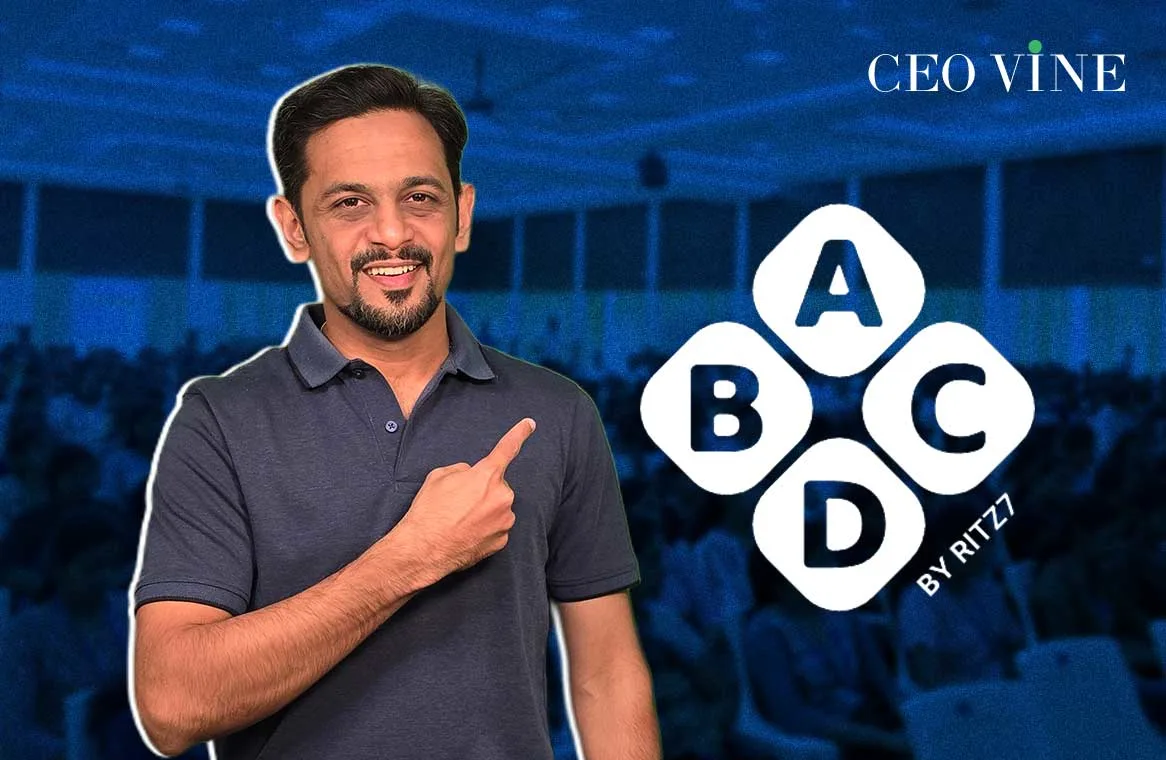
    This is the space in which ABCD by Ritz7, founded by Ritesh Hegde under Ritz7 Automations, found its purpose as a community-led learning ecosystem where people learn to design, develop and deploy real solutions using no-code and AI tools. ABCD, short for Anybody Can Design, Develop and Deploy has grown into a learning and community ecosystem focused on building real-world skills through no-code and automation.

    Ritesh understands this space closely. Before ABCD, he had already delivered more than 450 automation and no-code projects across 30 countries and trained upwards of 15,000 learners through platforms such as GrowthSchool, Buildschool and 100x. For him, the rise of no-code signaled something larger, a shift in who gets access to technology.

    “There are people with ideas, ambition and clarity, but they don’t have coding skills. No-code removes that barrier. ABCD became our way of making tech possible for anyone willing to learn,” he says.

    How ABCD Took Shape Inside Ritz7

    In early 2024, Ritesh created a small knowledge-sharing group under Ritz7 Automations where he discussed tools like Bubble, n8n and early AI agents. The sessions were informal, often built around real client problems or simple workflows. But the response made it clear there was a larger need.

    Participants wanted more guidance, more practice, more community. The group grew steadily as students, professionals, freelancers and early-stage founders began showing up to understand how they could build or automate without coding. Within months, the informal initiative developed into a structured program. Cohort-based learning tracks, weekly challenges, college workshops and community activities followed.

    This growth was also shaped by Ritesh’s belief that learning has to be hands-on to create impact. 

    “People don’t want theory. They want to build something that works,” he says.

    A Community That Learns by Building

    Today, ABCD by Ritz7 functions less like a traditional edtech platform and more like a community-led learning movement. The platform attracts a diverse group of students preparing for tech-driven careers, freelancers building automation services, founders working on MVPs and professionals trying to streamline their workflows with AI and no-code tools.

    The community has crossed 1,000 members since launch, growing through WhatsApp groups, workshops, structured learning paths and word-of-mouth referrals. What keeps the community active is the culture of continuous building. There are weekly office hours, challenge-based assignments, live sessions and public showcases where members demonstrate what they have built.

    One of the standout initiatives is the 1000-Day AI Challenge, which has already crossed 350 days. Members participate daily, share learnings, experiment with new tools and gradually build confidence in AI automation. The challenge has turned consistency into a habit and helped learners ship their first functional systems without waiting for formal certifications.

    ABCD’s reach expanded further through its partnerships with educational institutions. In one of its largest engagements, the team trained more than 1,600 students in a single college, introducing them to no-code tools and showing how these skills open up freelance and career opportunities.

    What ABCD by Ritz7 Offers

    ABCD’s programs revolve around helping people build apps, automate workflows and use AI tools with guided practice. The sessions are simple, structured and solution-oriented. Instead of teaching abstract concepts, the team walks learners through real business problems, breaking them down into buildable modules.

    The brand’s consulting arm strengthens the model. Ritz7 Automations works with businesses across the globe to build automation systems, internal tools and operational workflows. The experience gained through 450+ projects has allowed the ABCD learning framework to stay aligned with actual industry demand.

    A Bootstrapped Company With Steady Growth

    ABCD by Ritz7 is fully bootstrapped and no external funding has been raised. Founder Ritesh confirms the team does not plan to seek investment.

    The business operates on a hybrid model involving workshops, structured training programs, consulting services, institutional partnerships and upcoming membership layers. Its sustainability is built on lean operations, high-quality delivery and a clear focus on practical outcomes.

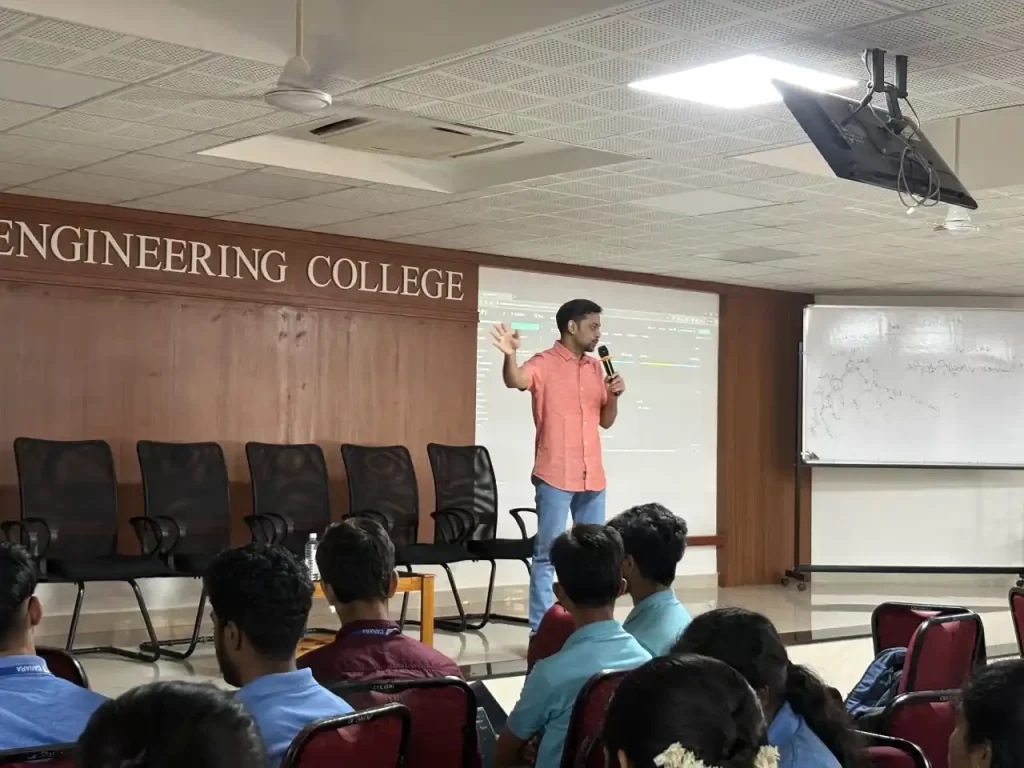
    Ritesh Hegde -  conducting workshop at Canara Engineering College
    Ritesh Hegde – conducting workshop at Canara Engineering College

    ABCD by Ritz7 has trained more than 15,000 learners through external collaborations, completed automation projects for clients in more than 30 countries, supported over 500 individuals and businesses through no-code solutions and expanded its community to 1,000 active members. Retention remains strong, with 85–90% of participants returning for more sessions, challenges or advanced tracks.

    Overcoming Challenges in the Early Phase

    Despite its momentum, building awareness for no-code wasn’t easy. Many traditional businesses initially believed automation required full-scale coding. Convincing them otherwise required a different approach.

    The team relied on demonstrations and case studies, showing real systems built on no-code platforms. Once clients saw functional internal tools or automated workflows running smoothly, perception shifted.

    Building credibility in the education segment came with its own learning curve, but strong collaborations with major platforms like GrowthSchool and Buildschool helped cement ABCD’s identity as a practical, industry-focused learning ecosystem.

    The Larger Market Context

    India is at the beginning of what many believe will be a significant no-code shift. Automation is becoming essential for companies trying to reduce operational friction. Early-stage founders now prefer rapid MVP development rather than investing heavily in engineering in the initial months. Students are increasingly drawn toward job-ready tools that allow them to build portfolios early.

    No-code and AI-led automation sit at the center of this shift. The demand for talent that understands these tools is rising, yet the supply of structured learning ecosystems remains small. ABCD’s emergence coincides with this demand wave and is aligned with a larger transition in how technology is being built, learned and deployed.

    https://app.ceotrail.com/luzo-app-indias-1-beauty-tech-platform/

    The Road Ahead for ABCD by Ritz7

    In the next 1–2 years, ABCD plans to deepen its community programs, expand its presence across colleges and launch more structured learning paths focused on AI agents, automation workflows and beginner-friendly no-code tracks.

    The long-term vision includes international expansion, proprietary tools and enabling one million automations for businesses and individuals.

    The company’s goal is to make no-code and automation skills practical, accessible and outcome-driven, and to empower people to build without traditional barriers.Ritesh sums up the vision simply:

    “We want to build an ecosystem where anyone, whether a student, founder or professional can build, automate and innovate without code. The future of work is going to be shaped by people who can do more with less complexity.”

    FAQs

    In ABCD by Ritz7, what does ABCD stand for?

    ABCD stands for Anybody Can Design, Develop and Deploy.

    Who can join ABCD by Ritz7?

    Students, freelancers, founders or working professionals, who wants to learn how to automate workflows, build apps or create AI-driven solutions can join the community.

    Is ABCD a free or paid platform?

    ABCD follows a hybrid model. It offers free community access, challenges and events, while workshops, structured programs and institutional training are paid offerings.

    Who is the founder of ABCD by Ritz7?

    ABCD is founded by Ritesh Hegde, a no-code automation expert.

    Is ABCD funded by investors?

    No, ABCD is entirely bootstrapped. The company has not raised external funding and is currently focused on sustainable, community-led growth.