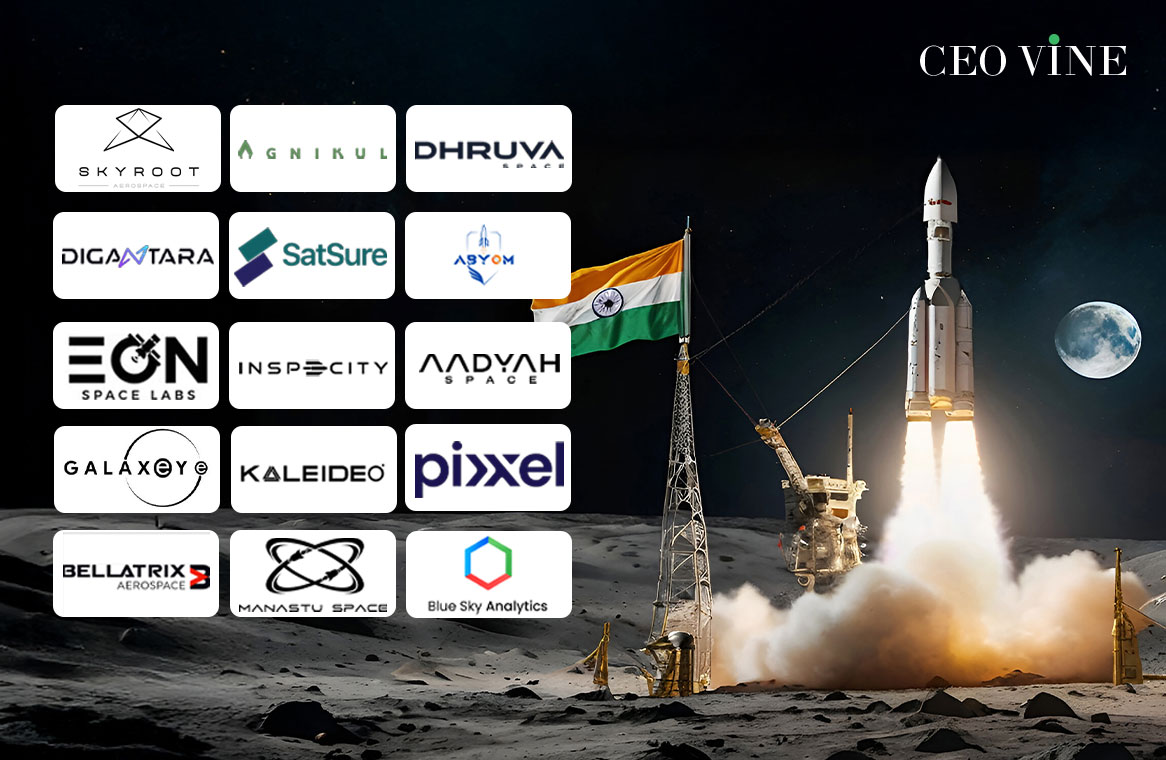
Traveling beyond Earth was once a distant dream, limited to government scientists, massive rockets, and decades-long timelines. But the scene has changed dramatically. A new generation of spacetech startups in India is rewriting the playbook, launching rockets, building satellites, and creating technologies that make the final frontier more accessible, sustainable, and commercially viable.
A decade ago, space exploration in India was dominated by ISRO alone. Fast forward to today, India’s spacetech ecosystem is buzzing with young founders, bold investors, and record-breaking missions. The momentum is real: India’s space economy, currently valued at around $8 billion, is projected to grow fivefold to $44 billion by 2033, increasing its global market share from 2% to 8%.
Recent Indian government moves are fueling this growth. In 2024, India’s Department of Space was allocated $1.6 billion, and Finance Minister Nirmala Sitharaman announced a ₹1,000 crore (~$120 million) venture capital fund dedicated to supporting around 40 homegrown spacetech startups over the next decade.
Spacetech Startups in India to Watch in 2025
From launch vehicles to Earth observation, AI-powered satellite tracking to green propulsion, India’s spacetech startups are betting big on new-age innovation. Here are 15 promising names reshaping India’s position in the global space race.
Skyroot Aerospace
Founded: 2018, Hyderabad
Founders: Pawan Kumar Chandana & Naga Bharath Daka
Skyroot Aerospace is India’s most well-known private rocket startup, pioneering affordable launch vehicles for small satellites. The ex-ISRO founders imagined “Uber for space”—reliable, flexible rides to orbit for commercial payloads.
In 2022, they launched Vikram-S, India’s first privately built rocket. Their flagship Vikram-1 (due 2025) will deliver up to 500 kg to Low Earth Orbit at competitive costs.
With $95 million raised, Skyroot is expanding into reusable rocket stages, green fuels, and building Asia’s first privately owned rocket manufacturing facility. They plan to serve hundreds of global satellite makers with quick, cost-efficient launches.
AgniKul Cosmos
Founded: 2017, Chennai
Founders: Srinath Ravichandran & Moin SPM
AgniKul Cosmos made headlines for its fully 3D-printed rocket engines—an industry first. Incubated at IIT Madras, the startup’s modular launch vehicle AgniBaan can be customized for payloads from 30 to 300 kg. In 2024, it launched AgniBaan SOrTeD from India’s first private launchpad.
With over $40 million in funding, AgniKul is building India’s first private rocket factory. They’ve signed multiple MoUs with ISRO for testing and launch integration, signaling strong public-private synergy. AgniKul aims to make satellite launches as simple as booking a flight.
Dhruva Space
Founded: 2012, Hyderabad
Founder: Sanjay Nekkanti
A true pioneer among spacetech startups in India, Dhruva Space delivers end-to-end satellite solutions—from design to deployment and ground operations. They’ve launched satellites for both domestic and international clients, including student payloads and defense-grade missions.
In 2022, Dhruva deployed India’s first private CubeSats on ISRO’s PSLV. By 2024, they launched ground-station-as-a-service offerings. With $19 million in funding, Dhruva’s vision is to become India’s “SpaceX for small satellites”—democratizing access for research, telecom, IoT, and climate applications.
Bellatrix Aerospace
Founded: 2015, Bengaluru
Founders: Rohan Ganapathy & Yashas Karanam
Bellatrix specializes in electric propulsion systems that cut satellite costs and extend lifespan. From green propellants to water-based plasma thrusters, their innovations are replacing toxic fuels like hydrazine.
They’re also working on orbital transfer vehicles to reposition satellites mid-mission—key for mega-constellations.
Backed by $11 million, Bellatrix’s propulsion tech has flown on three test missions and has secured commercial contracts with global satellite operators. Their next milestone: a dedicated “space taxi” to move satellites between orbits cost-effectively.
Also Read | When Tech Meets Faith: 15 Spiritual Tech Startups Changing How India Prays
Pixxel
Founded: 2019, Bengaluru & California
Founders: Awais Ahmed & Kshitij Khandelwal
Pixxel is building one of the world’s densest hyperspectral satellite constellations and aiming for 24 satellites capturing rich spectral data invisible to normal cameras. This can detect crop disease, pollution, oil leaks, or hidden minerals.
With $71 million raised, Pixxel’s “Aurora” analytics platform converts raw imagery into actionable insights for agriculture, mining, insurance, and climate research. The startup launched three satellites already and plans daily global coverage by 2025.
NASA has also selected Pixxel to supply hyperspectral data for its research programs—proof of India’s growing credibility in advanced Earth observation.
GalaxEye Space
Founded: 2020, Chennai
Founders: Denil Chawda, Kishan Thakkar, Pranit Mehta, Rakshit Bhatt & Suyash Singh
GalaxEye’s Drishti satellite combines Synthetic Aperture Radar (SAR) and Multispectral Imaging (MSI)—a first in India. This hybrid capability means sharper, weatherproof, day-and-night imaging—vital for defense, disaster response, and smart farming.
They recently closed a $10 million Series A, opened a state-of-the-art assembly lab, and have pilot customers lined up in Southeast Asia. By 2025, GalaxEye aims to have its full constellation in orbit, powering data-driven resilience for governments and businesses.
Digantara
Founded: 2018, Bengaluru
Founders: Anirudh Sharma, Rahul Rawat & Tanveer Ahmed
Digantara tackles the “junk in space” problem by mapping debris and traffic in Earth’s orbits. Their Space-MAP platform integrates multiple data streams to track and predict orbital hazards, akin to Google Maps but for satellites.
In 2023, they launched Pushan-Alpha, India’s first private debris-tracking satellite. With a partnership with SpaceX for its next launch and international clients testing the platform, Digantara is on its way to making space safer for all.
SatSure
Founded: 2017, Bengaluru
Founders: Prateep Basu, Rashmit Singh Sukhmani & Abhishek Raju
SatSure merges satellite imagery with AI and IoT data to power decision intelligence across agriculture, banking, and infrastructure. Think yield forecasts, flood monitoring, or crop insurance validated from space.
With India’s top banks as clients, SatSure is working on launching its own micro-satellite fleet to make its insights even sharper. They’re also expanding to Africa and Latin America, targeting sectors like climate adaptation and sustainable farming.
Abyom
Founded: 2020, Gorakhpur
Founder: Amit Kumar Singh
Abyom is developing reusable rocket stages and a plug-and-play engine test platform. Its goal: to bring launch costs down drastically by reusing hardware and simplifying the testing cycle for private clients.
Freshly funded with $2.5 million seed capital, Abyom’s prototype engines are undergoing hot fire tests this year. They aim to launch test missions by 2026.
Manastu Space
Founded: 2017, Mumbai
Founders: Tushar Jadhav & Ashtesh Kumar
Manastu is tackling the dual threat of space debris and toxic fuels. Their non-toxic green propulsion system is safer and more efficient than traditional fuels. They’re also building in-orbit refueling and debris-removal services.
With $3 million secured, Manastu is partnering with satellite manufacturers and defense agencies to expand India’s share in global satellite maintenance.
Blue Sky Analytics
Founded: 2018, Gurugram
Founders: Abhilasha Purwar & Kshitij Purwar
Blue Sky Analytics transforms satellite data into climate risk dashboards for insurers, investors, and policymakers. From wildfires to air quality, their API feeds help businesses comply with ESG mandates and climate disclosure frameworks like TCFD. With international partnerships brewing, they’re expanding data offerings for Southeast Asia and Africa next.
KaleidEO (SatSure Subsidiary)
Founded: 2022, Bengaluru
Parent: SatSure
KaleidEO brings real-time analytics to orbit with edge-computing satellites—processing imagery directly in space to speed up insights. It’s the first Indian firm to test edge computing in flight. Four satellites are due to launch by 2025, giving agriculture, mining, and defense players more precise, fast data.
Eon Space Labs
Founded: 2022, Hyderabad
Founders: Punit Badeka, Manoj Kumar Gaddam & Sanjay Kumar
Eon Space Labs develops compact, high-res optical payloads for satellites and drones. Their DEGA payload is designed for easy integration, giving startups and research labs advanced imaging capability at lower costs. They’re building a mini-constellation for infrastructure monitoring across India.
InspeCity
Founded: 2022, Mumbai
Founders: Prof. Arindrajit Chowdhury & Dr. Tausif Sheikh
InspeCity is India’s answer to satellite servicing—robotic arms and autonomous drones to repair, refuel, and reposition satellites in orbit. Incubated at IIT Bombay, the startup raised $1.5 million in pre-seed funding and is working with ISRO’s POEM mission as a testbed. Their moonshot? A modular orbital habitat to house humans in space by 2030.
Aadyah Aerospace
Founded: 2016, Bengaluru
Founder: Shaju Stephen
Aadyah Aerospace develops smart actuators, satellite deployment systems, and electro-optics for India’s growing satellite and drone market. Their cube set dispensers ensure safe deployment of mini-satellites to orbit. With early US backing, Aadyah supports defense, ISRO projects, and new private rocket ventures—making them a quiet but powerful force in India’s space supply chain.
Where India’s Space Story Is Headed
The next decade will see India’s spacetech startups push boundaries once thought impossible. Backed by supportive policies, growing private capital, and world-class talent, India’s new-age space startups are not just launching rockets—they’re unlocking billion-dollar industries in Earth observation, debris tracking, green propulsion, and in-orbit sustainability.
As we look ahead, spacetech startups in India aren’t just aiming for the stars. They’re building the ladders, engines, satellites, and systems that will define humanity’s next leap beyond Earth.